What Is Filipino Adobo? The Story Behind One of the Philippines’ Most Iconic Dishes
If there’s one Filipino dish almost everyone has heard of, it’s probably adobo. But ask a group of Filipinos how to make it and you might get a completely different answer from every person—and honestly, that’s part of what makes adobo so special.
Growing up in the Philippines, I never really thought of adobo as an “iconic Filipino dish.” It was simply food. It was the kind of ulam (dish eaten with rice) you ate at home with hot rice, and every family seemed to have their own way of making it.
Some like their adobo saucy. Others cook it until the sauce is almost completely reduced. Some make it sweeter, some more vinegary, and some will probably tell you their family’s version is the only way to do it. 😂
But the more I think about it now, the more I realize that adobo actually says a lot about Filipino food. The ingredients can be simple, the flavors are anything but boring, and somehow the same dish can taste completely different depending on whose kitchen you’re eating it in.
So, What Exactly Is Filipino Adobo?
The easiest way I can explain adobo is that it’s really more of a way of cooking than one exact recipe.
Meat, seafood, or even vegetables can be cooked adobo-style, usually with vinegar and seasonings. One of the versions most people recognize today uses vinegar, soy sauce, lots of garlic, bay leaves, and whole black peppercorns.
Pork and chicken are probably the most familiar, but adobo definitely doesn’t stop there.
And here’s one thing you’ll learn pretty quickly if you start talking to Filipinos about it:
There isn’t just one adobo.
The version you grew up eating might be completely different from someone else’s.
And both families will probably insist theirs is better. 😂
Even the Philippine Department of Trade and Industry’s Bureau of Philippine Standards has acknowledged the many regional variations of adobo. When work began on defining a basic standard for the dish, the goal wasn’t to declare one recipe the “correct” adobo, but to identify the basic cooking technique while recognizing the different ways Filipinos make it.
And honestly, I like it that way.
Where Did Filipino Adobo Come From?
This is something I honestly never thought much about growing up.
Adobo was just adobo.
But when I started looking into its history, I found out the story is actually pretty interesting—and it’s not as simple as saying, “Adobo came from Spain.”
From what I found, vinegar-based cooking was already being practiced in the Philippines before Spanish colonization. In a tropical climate without refrigeration, cooking food with vinegar was also a practical way to help preserve it. Smithsonian discusses this older vinegar-based cooking tradition, while the Philippine Information Agency cites historian Augusto de Viana on evidence supporting native roots for adobo.
So where does Spain come into the story?
The name.
When the Spanish encountered this way of preparing food in the Philippines, they used the word adobo to describe it. The term is connected to the Spanish word adobar, meaning to marinate or season.
So basically?
The word “adobo” may be Spanish, but that doesn’t mean Filipino adobo simply came from Spain.
And I think that’s such an interesting little piece of food history because I certainly wasn’t thinking about any of this while eating adobo growing up. 😂
Over time, Filipino adobo continued to change and evolve, which helps explain why we have so many versions today.
Looking for the recipe?
Make my Filipino Pork Adobo Recipe →
What Does Filipino Adobo Taste Like?
If you’ve never had Filipino adobo before, the first thing to know is that it’s usually savory, tangy, garlicky, and perfect with rice.
Vinegar gives it that recognizable tang. In versions that use soy sauce, you also get that deeper salty, savory flavor. Then you have garlic, peppercorns, bay leaves, and whatever else that particular cook or family likes to add.
But again, there’s no single flavor profile that describes every adobo.
Some versions are:
- More vinegary
- A little sweeter
- Extra garlicky
- Darker and saltier
- Very saucy
- Almost dry
- Spicy
- Rich and fatty
Personally, I like mine with plenty of sauce because I need something to spoon over my rice. 😂
Different Types of Adobo in the Philippines
This is another reason I hesitate whenever someone talks about the “authentic adobo recipe.”
Which adobo?
Because there are a lot of them!
Here are just a few versions you might come across.
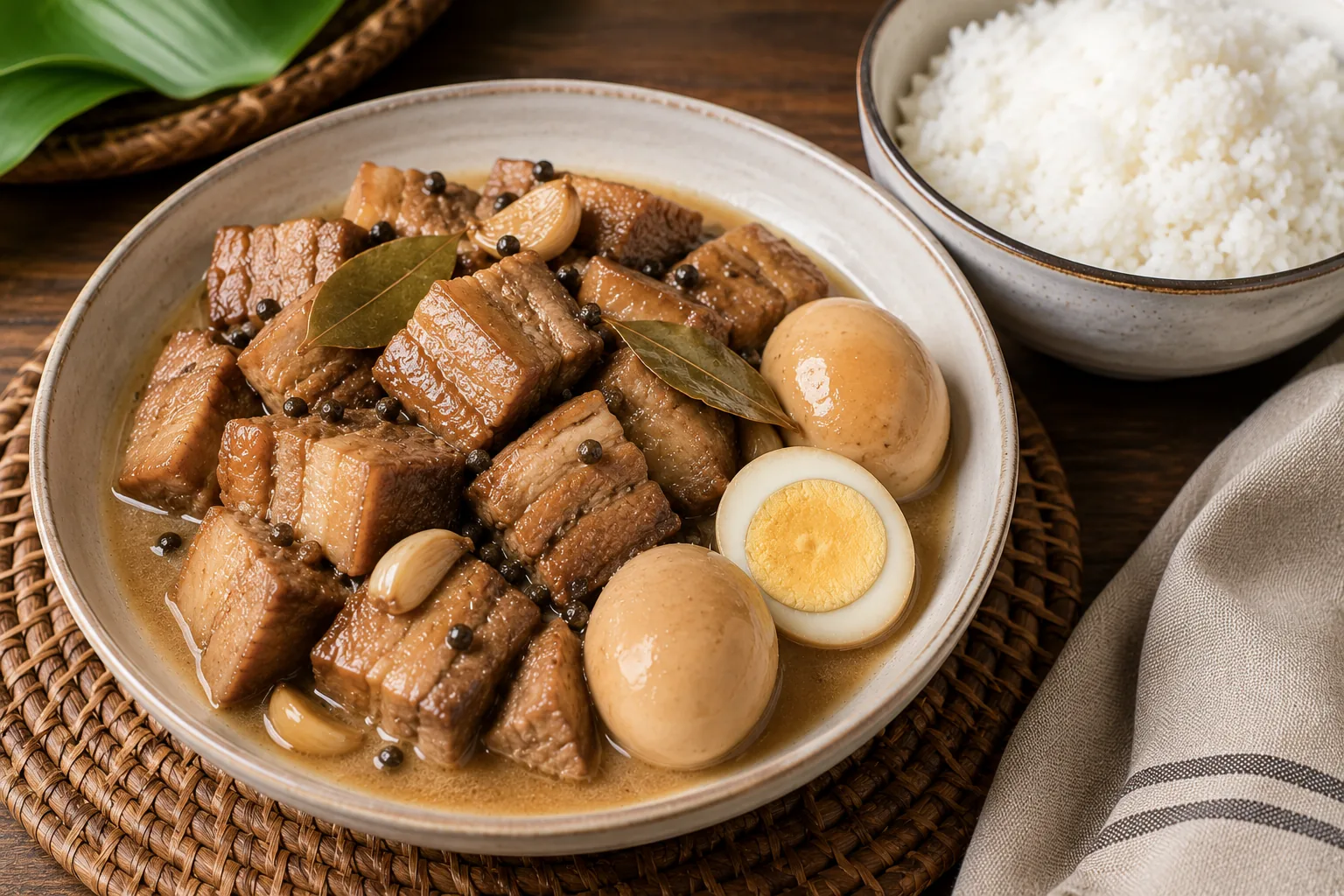
Adobong Baboy
Adobong baboy simply means pork adobo.
This is one of the versions I grew up eating and the one I make at home most often. Pork is simmered until tender and absorbs all that savory, tangy adobo flavor.
And yes, this is the version I have a recipe for here on the site.
Adobong Manok
Adobong manok is chicken adobo.
Some families make it entirely with chicken, while others combine chicken and pork in the same pot.
Adobong Puti
This one is a good reminder that soy sauce isn’t required for adobo.
Adobong puti, or white adobo, doesn’t have the dark soy-based sauce many people associate with the dish. Vinegar and salt play a bigger role instead.
So if someone tells you all Filipino adobo has to contain soy sauce… well, not exactly. 😉
Adobong Pusit
Yes, squid can be adobo too!
Adobong pusit is made with squid and often incorporates its ink, giving the dish its distinctive dark appearance and rich flavor.
Adobong Kangkong
And adobo doesn’t even have to contain meat.
Kangkong, or water spinach, can also be cooked adobo-style with vinegar, garlic, and seasonings.
Those are only a few examples. Different regions and families have their own ingredients, techniques, and preferences, which is one of the things I love about Filipino food. The Philippine Bureau of Standards also notes the variety of ingredients and cooking methods found in regional versions of adobo.
Is Adobo Really the National Dish of the Philippines?
You’ll see adobo called the national dish of the Philippines all over the internet.
But this is another thing I looked into while writing this article.
I think it’s more accurate to call adobo an unofficial national dish.
It’s definitely one of the foods most closely associated with the Philippines, but there have actually been proposals to formally designate it as the country’s national food. A Philippine House bill introduced in 2014, for example, proposed doing exactly that.
So while I wouldn’t say adobo has always been the Philippines’ officially designated national dish, there’s no question that it has become one of the foods people most strongly associate with Filipino cuisine.
And maybe it’s fitting that one of our most recognizable dishes doesn’t even have one recipe everyone agrees on.
That sounds pretty Filipino to me. 😂
Why Is Adobo So Special to Filipinos?
I obviously can’t speak for every Filipino, but for me, adobo is special because it feels like home food.
It doesn’t have to be fancy.
You make a pot of it, cook some rice, put everything on the table, and eat.
And because families make adobo differently, the version you love can be connected to a person or a memory.
Maybe it tastes like the adobo your mom made.
Maybe your grandmother had her own version.
Maybe your family likes it really vinegary, while someone else’s family puts sugar in theirs.
Those little differences are part of the story.
Living in the U.S. has made me appreciate things like that even more. Sometimes all it takes is the smell of garlic cooking or a pot of adobo simmering on the stove, and suddenly the Philippines doesn’t feel quite so far away.
What Do You Eat With Filipino Adobo?
For me, there is really only one answer:
Hot steamed rice. And plenty of it. 😂
Adobo sauce and rice just belong together.
The rice soaks up all that salty, tangy, garlicky sauce, and honestly, sometimes that’s all you need.
You can definitely serve vegetables or another Filipino side dish with it if you want a bigger meal.
And if you have leftover adobo?
Save it.
Adobo is one of those dishes that can be even better the next day after all those flavors have had more time together.
Want to Make Filipino Pork Adobo?
Now that I’ve spent this entire article talking about adobo, I feel like I should probably feed you. 😂
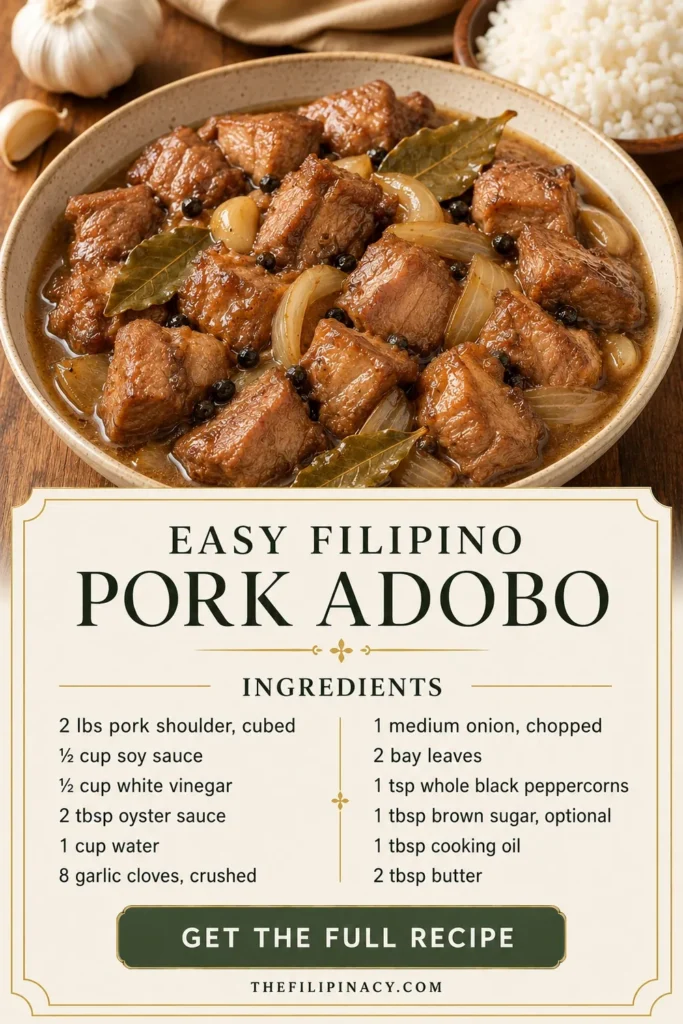
If you want to try making it yourself, I have my own Filipino Pork Adobo Recipe here on the site.
My version uses pork shoulder, soy sauce, vinegar, oyster sauce, lots of garlic, onion, bay leaves, black peppercorns, sugar, and a little butter.
It’s savory, tangy, garlicky, a little sweet, and has plenty of sauce for rice—which is exactly how I like it.
→ Try My Filipino Pork Adobo Recipe
More Than Just Adobo
Adobo may be one of the most famous Filipino foods, but what I love about it is that there isn’t just one version that represents everyone.
It changes from region to region, kitchen to kitchen, and family to family.
And I think that’s part of what makes Filipino food so interesting.
We take familiar dishes, make them our own, pass them down, argue about whose version is better 😂, and then gather around the table and eat them together.
So if someone ever tells you there is only one correct way to make Filipino adobo, you might want to ask a few more Filipinos first.
Kain tayo! 🇵🇭
A Little More About the History
I’m definitely not a food historian, so I did a little digging while writing this! If you’re curious about the history of Filipino adobo too, these are some of the sources I used.
Philippine Information Agency — Beyond the Flavor: What Makes Filipino Cuisine Uniquely Ours? — Includes discussion of adobo’s origins and the Spanish terminology.
Department of Trade and Industry, Bureau of Philippine Standards — Standardization of Famous Filipino Dishes Advances! — Discusses the different regional versions of adobo and the idea of defining a basic cooking technique rather than one recipe.
Smithsonian Magazine — Filipino Cuisine Was Asian Fusion Before “Asian Fusion” Existed — Provides additional background on vinegar-based cooking and Filipino culinary history.